Meet the Light Artist: Amy Jackson
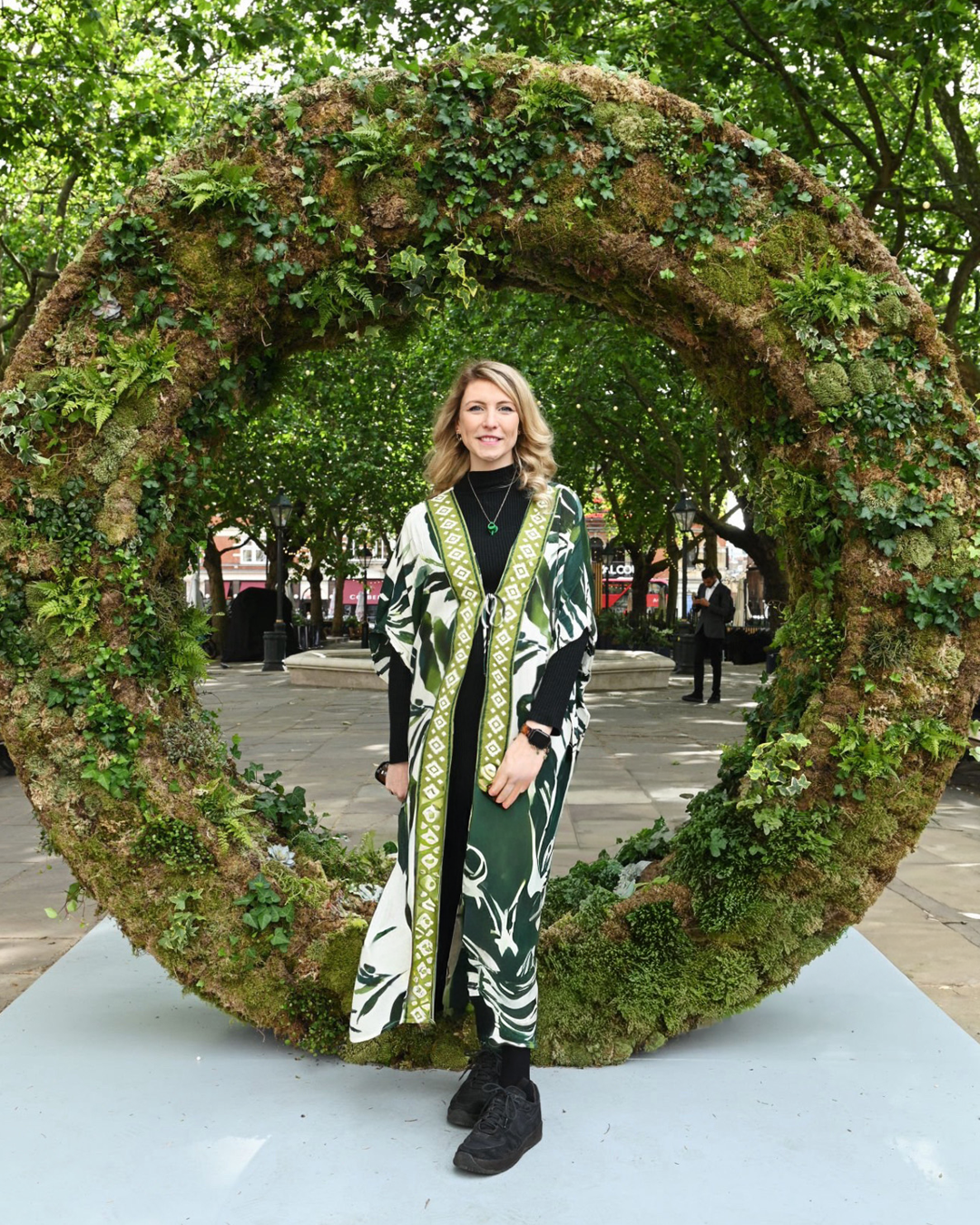
Amy Jackson with her work Living London, 2024, for Kensington & Chelsea Art Week. Photo: Dave Benett. © Amy Jackson.
Amy Jackson is a conceptual artist and sustainability specialist whose work blends philosophy, nature, and science to create immersive experiences in both traditional galleries and public spaces. For Light Up Kilburn 2026, Amy will bring her Invisible Tree Network to Kilburn Grange Park, revealing the hidden connections between trees, fungi, and communities. We sat down with Amy in our Meet the Light Artists series to discuss her approach, the inspirations behind her work, and what visitors can expect from the festival.
How did you get started as a light artist, and what does Kilburn mean to you?
As a conceptual artist I always start with an idea or a question, not with a particular material. I am interested in systems, stories and emotions, and then I choose whatever medium can express that most clearly. Sometimes that means a drawing, a sculpture, a map made of data, a participatory workshop or even a temporary intervention in public space. Light has become one of my key materials because it can be both very practical and very poetic. It can trace movement, reveal hidden structures, change how a place feels at night and make data or stories visible without adding physical clutter or waste.
I first started working with light when I was living in Kilburn, in a tiny flat at quite a difficult time in my life. I had just moved to London and was working as an art director in an industry that did not align with my values. Outside, the high road was always lit by shop signs, traffic and late night life; inside, I was experimenting with cheap LEDs, projectors and reflections as a way to test ideas after work. That period of feeling out of place pushed me to change direction completely, retrain in sustainability and eventually bring those concerns back into my art.
Kilburn, for me, is where those threads first met. It is where I learned how powerful light can be in public space and where I realised that my practice could sit between art, everyday life and environmental responsibility.
How does your work connect to the Light Up Kilburn 2026 themes of biodiversity and women’s safety?
My concept Invisible Tree Network connects the two themes by treating light as a way to reveal care, both for non-human life and for people moving through the city at night.
Biodiversity wise, the work maps the hidden life of trees onto the ground, turning root systems, mycelium and soil ecosystems into delicate lines and nodes of light. Instead of floodlighting canopies, which can disrupt birds and insects, the installation focuses on low level, ground based illumination that traces where trees are, where their roots might spread, and how they link to each other. It quietly teaches people that pavements, verges and pocket parks are part of a living network, not empty leftover space.
For women’s safety, those same lines of light become legible, continuous pathways. The network can highlight safe routes between bus stops, stations and key destinations, soften dark corners, and make sightlines clearer without creating harsh glare or deep shadow. I would work with local women and girls to map where they currently feel exposed or invisible at night, then use that feedback to shape the exact placement of the light traces. The result is an environment that feels held and connected rather than isolated.
“I hope the work will gently change how people see their own streets, once they’ve walked through the projection, they can’t quite look at a tree, a verge or a patch of pavement in the same way again.”
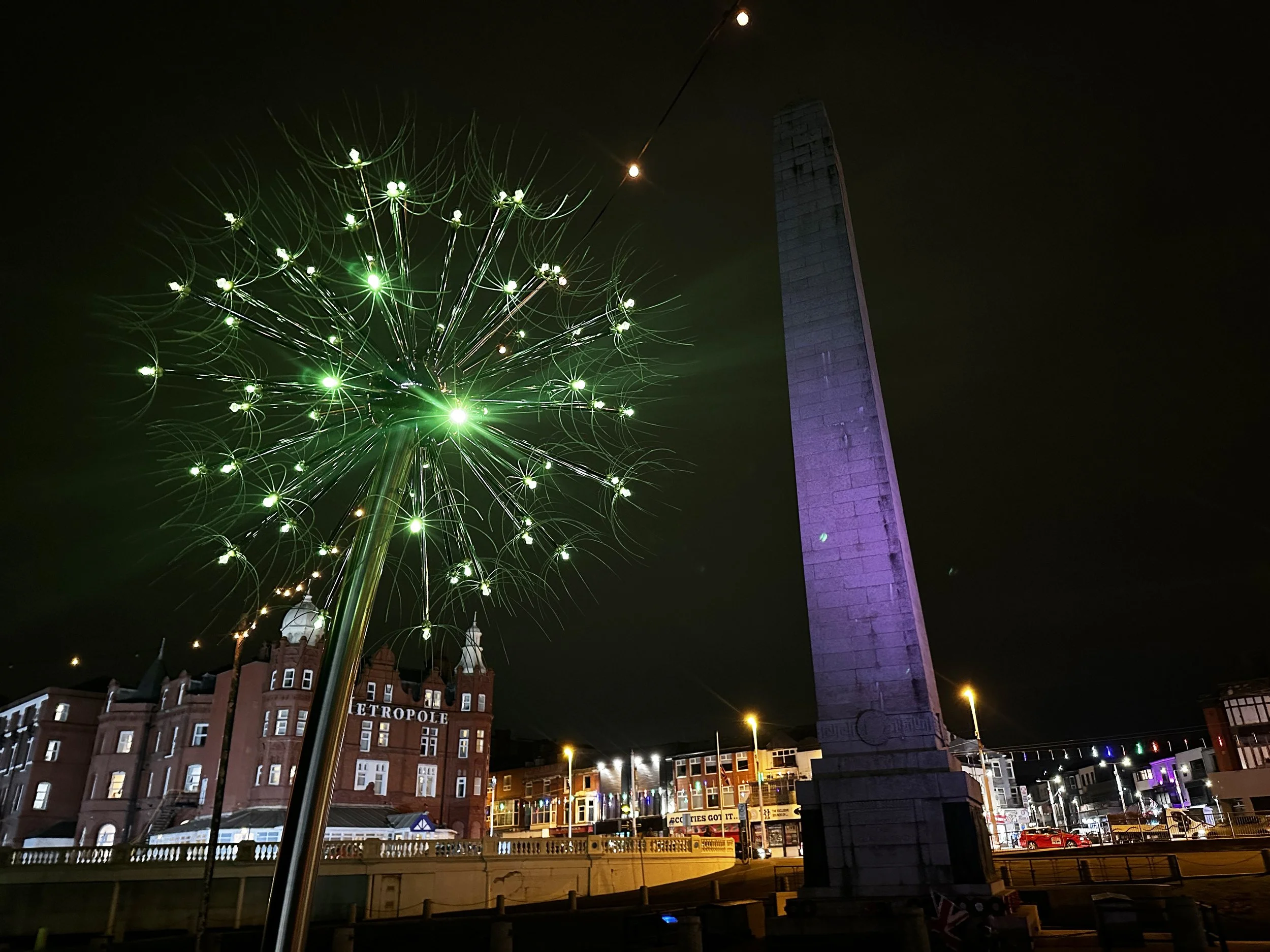
The Wish, 2025, by Amy Jackson at Blackpool War Memorial for Lightpool Festival. © Amy Jackson.
What can visitors expect from your piece at the festival?
Visitors will encounter a large-scale gobo projection that transforms the pavement into a glowing map of the underground life of trees. Instead of lifting their eyes to the canopy, they’ll be drawn to look down, where a delicate web of roots and fungal threads unfurls in light beneath their feet. The imagery is grounded in real science: tree root systems spreading laterally in search of water and minerals; fine mycorrhizal filaments forming what scientists call the “wood wide web,” allowing trees to exchange nutrients and chemical signals; and the complex soil micro-habitats where bacteria, fungi and tiny invertebrates work constantly to recycle matter and store carbon. All of this is translated into branching lines, nodal clusters and almost cellular patterns, suggesting not just individual trees but a shared, living network.
The atmosphere is designed to be quietly immersive rather than overpowering. The light is soft and low, avoiding harsh glare so that people feel able to pause, step into the projection and literally stand inside the “network.” Children may follow the lines as if they are paths in a game; teenagers might use the intricate patterns as a backdrop for night-time photographs; adults may find themselves unexpectedly moved by the realisation that an ordinary London street sits on top of this constant, invisible activity. Some viewers will simply enjoy the projection as a beautiful, lace-like drawing in light. Others, after reading the short explanation, will recognise that they are seeing a visualisation of how trees communicate, cooperate and keep urban ecosystems alive. The hope is that people walk away with a subtle but lasting shift in perception: the ground beneath them no longer feels inert, but alive, and they begin to sense themselves as part of that network rather than separate from it.
I hope that viewers will never walk past a tree again without thinking of the world differently, almost imagining the invisible magical world underneath our feet.
What materials or techniques are you using, and why?
For Invisible Tree Network I’m using light as the primary material, delivered through gobo projection on the ground. The images of roots and mycelium are created as high-contrast, vector-based artworks, which are then projected via gobos. This approach allows the patterns to be precise and lace-like, almost like a scientific diagram, while remaining robust enough for outdoor public use in all weather conditions.
I’m deliberately keeping the light low-level and ground-focused rather than floodlighting trees or façades. That choice is both conceptual and practical: conceptually, it emphasises what we usually overlook – the underground, the edges of pavements, the “in-between” spaces – and practically, it reduces light pollution and disturbance for nocturnal insects, birds and residents. The technique also supports women’s safety: by softening dark patches and clarifying routes without creating harsh glare or deep shadow, it makes streets feel more legible and welcoming at night.
Behind the scenes, I’m using a mix of digital mapping, drawing and scientific research to understand what the hidden network of the specific tree I will project from would actually look like in real life. Tree locations and canopy spreads are translated into imagined root and fungal networks, which are then refined by hand so the projection feels both scientifically informed and visually poetic. Choosing projection, rather than a heavy physical installation, keeps the intervention light-touch on the environment, easy to install and remove, and accessible to people using wheelchairs, prams or mobility aids – they can move straight through the work without barriers, literally walking inside the network the piece is revealing.
Alongside the artwork, I will look forward to delivering community workshops to explore this topic, where local residents will use artistic techniques to map their own invisible networks.
“Invisible Tree Network connects biodiversity and women’s safety by revealing care for non-human life and people moving through the city at night.”

Living London, 2024, Kensington & Chelsea Art Week. Photo: Liz Isles. © Amy Jackson.
What do you anticipate will be the biggest challenge of creating your work outdoors?
The biggest challenge will be balancing visibility with sensitivity to the environment by designing a projection that stays crisp and legible in changing weather, ambient light and street conditions, while making sure the equipment is safely installed, low-glare and doesn’t create unwanted disturbance for residents, wildlife or people moving through the space.
What impact do you hope your work will have on the community, and how can locals get involved?
I hope the work will gently change how people see their own streets – that once they’ve walked through the projection, they can’t quite look at a tree, a verge or a patch of pavement in the same way again. By making the “invisible” life beneath our feet visible, the piece is really about care: care for non-human life, and care for the people who move through Kilburn at night.
Locals can get involved through a series of art workshops and walks where we’ll explore the hidden life of trees together. We might trace real root systems, learn about fungi and soil, map where people feel safe or exposed after dark, and then translate those ideas into drawings and patterns. Elements from these sessions can feed directly into the final projections – so residents are not just audiences, but co-authors of the visible worlds that appear on the ground. Ideally, people will come away feeling more connected to each other, more protective of local nature, and more confident in claiming the streets as shared, cared-for space.
“Light Up Kilburn 2026 is such a rare chance to experience the neighbourhood as an open-air gallery, with multiple voices interpreting the same themes in completely different ways.”
What are you most looking forward to at Light Up Kilburn?
I’m most looking forward to seeing how other artists respond to Kilburn itself – how they translate its trees, streets, shopfronts and night-time atmosphere into light. Light Up Kilburn 2026 is such a rare chance to experience the neighbourhood as a kind of open-air gallery, with multiple voices interpreting the same themes of biodiversity and women’s safety in completely different ways. I’m excited to walk the route, notice how each piece changes the feel of a corner or a crossing, and to hear how local women and young people respond to those shifts. For me, the real magic will be in the conversations that happen between works, and between neighbours, as people see their everyday streets lit, held and imagined anew.
One word to describe Light Up Kilburn?
Illuminating!
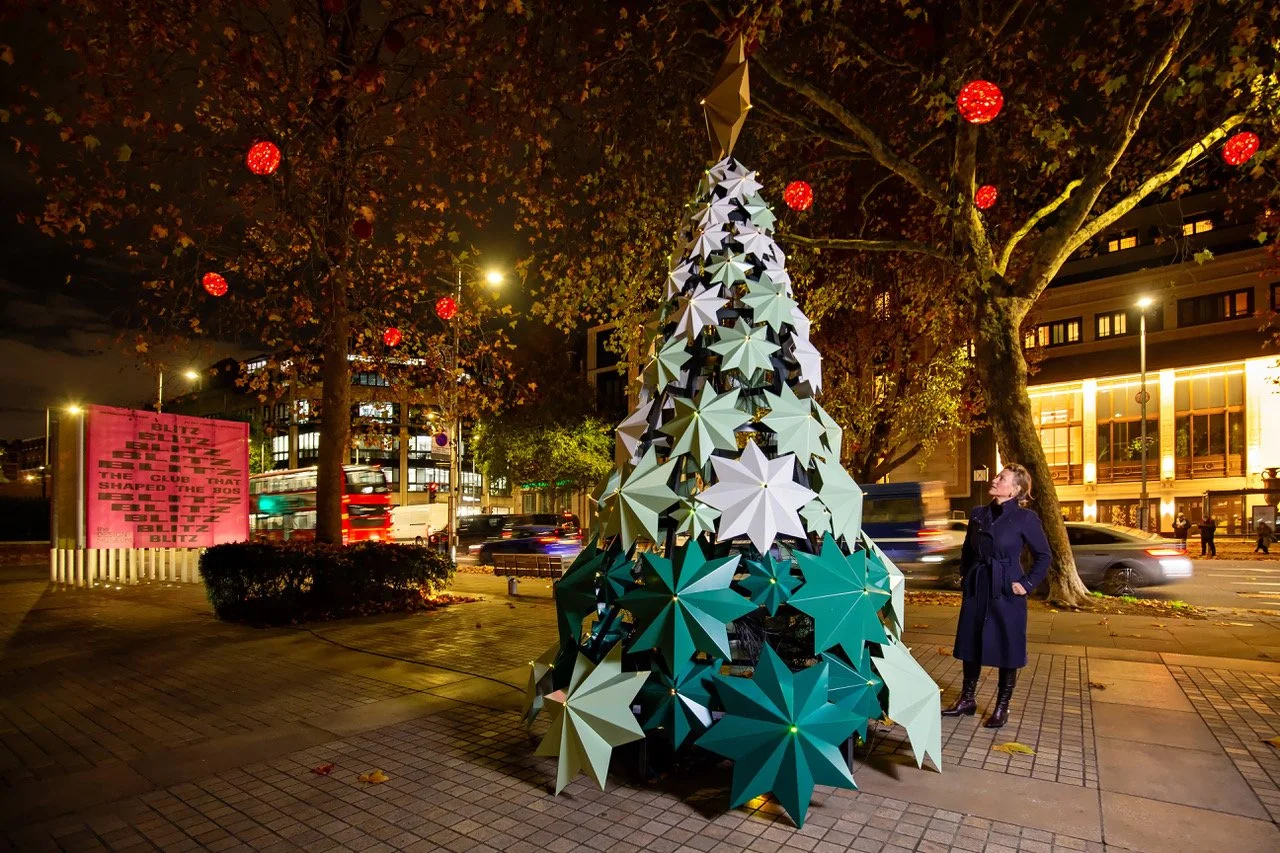
Oru, 2025, by Amy Jackson at the Design Museum Plaza, London. Photo: Mark Weeks. © Amy Jackson.